Why Your Body Does Not Heal Like It Used To

Understanding Recovery, Aging, and the Science of Cellular Repair
There is a moment many people recognize, even if they cannot pinpoint exactly when it started.
A workout that once left you pleasantly sore now leaves you stiff for three days. A minor injury lingers longer than expected. Sleep does not seem to restore you the way it once did. Stress accumulates faster, and it takes more time to feel like yourself again.
At first, it is easy to dismiss these changes.
Maybe you are busier. Maybe you are sleeping less. Maybe this is simply what getting older feels like.
But slower recovery is rarely caused by one thing alone. It is usually the result of several systems changing at the same time: inflammation becomes harder to regulate, hormone levels shift, cellular energy production becomes less efficient, sleep quality declines, and the body’s repair signals are not as strong or coordinated as they once were.
Healing has not stopped.
The body is simply working under different conditions.
Understanding those conditions is the first step toward improving them.
Recovery Is More Than Soreness
When people hear the word recovery, they often think about exercise.
But recovery is much broader than muscle soreness after a workout.
Your body is recovering constantly. It repairs tissue, restores energy, regulates inflammation, clears metabolic waste, balances hormones, and adapts to physical and emotional stress.
That repair work happens after exercise, but it also happens after illness, surgery, poor sleep, emotional strain, travel, and long periods of overwork.
A resilient body can absorb stress and return to baseline.
A body under chronic strain may never fully get back there.
Instead, fatigue, inflammation, stiffness, irritability, poor sleep, and reduced performance begin to overlap. What looks like a collection of unrelated symptoms may actually reflect a system that is struggling to complete its normal repair cycle.
Why Healing Changes With Age
Aging is often discussed as though it were a single process.
It is not.
It is a gradual shift across multiple systems that influence how quickly and effectively the body repairs itself.
Over time, muscle protein synthesis becomes less efficient. Hormonal signals may weaken. Mitochondria may produce energy less effectively. Inflammatory responses may remain active longer. Sleep becomes lighter and more fragmented. Circulation, nutrient delivery, and tissue turnover may also change.
None of this means decline is inevitable or that meaningful improvement is impossible.
It does mean the body may require more deliberate support than it did twenty years ago.
When you were younger, you may have been able to ignore sleep, skip meals, train aggressively, and still recover.
Later in life, the body becomes less forgiving.
That is not failure.
It is feedback.
The Role of Chronic Inflammation
Inflammation is essential for healing.
When tissue is injured, the immune system responds by increasing blood flow, recruiting repair cells, and initiating the rebuilding process. That response is normal and necessary.
The problem begins when inflammation does not resolve.
Chronic low-grade inflammation can interfere with tissue repair, increase pain sensitivity, disrupt sleep, contribute to insulin resistance, and make recovery feel incomplete.
Instead of moving through a clear cycle of stress, inflammation, repair, and adaptation, the body can become stuck in the middle.
This may show up as persistent soreness, joint stiffness, brain fog, poor exercise tolerance, or a general sense that the body is always working harder than it should.
Inflammation is not always caused by one dramatic illness. It can build gradually through poor sleep, excess alcohol, highly processed foods, chronic stress, inactivity, overtraining, excess body fat, and untreated health conditions.
The cumulative effect matters.
Cellular Energy Is Part of Healing
Every repair process requires energy.
Cells need energy to produce proteins, rebuild tissue, regulate inflammation, and restore normal function. Much of that energy is generated inside the mitochondria.
When mitochondrial function is impaired, the body may still heal, but it may do so more slowly and less efficiently.
This is one reason fatigue and poor recovery often appear together.
A person may not simply feel tired because they are busy. They may feel tired because the systems responsible for producing and allocating energy are under strain.
NAD+ is one of the molecules involved in cellular energy production and repair. It helps support mitochondrial function and several processes related to cellular maintenance.
Interest in NAD+ therapy has grown because of its potential role in energy, recovery, and healthy aging. It should not be viewed as a cure for fatigue or slow healing, but it may be one supportive tool for selected patients when used within a broader plan.
The larger point is that recovery is not only about muscles and joints.
It is also about the energy available to the cells doing the repair.
Sleep Is When Repair Happens
Most people understand that sleep matters, but many underestimate how much of the body’s repair work depends on it.
During sleep, the body regulates stress hormones, supports immune function, restores nervous system balance, consolidates memory, and releases signals involved in tissue repair.
Poor sleep does more than make you tired.
It can increase inflammation, reduce pain tolerance, impair glucose regulation, disrupt appetite, and decrease physical performance.
Even people who spend enough hours in bed may not be getting restorative sleep.
Frequent waking, sleep apnea, alcohol use, stress, pain, and inconsistent schedules can all reduce sleep quality.
When recovery is poor, sleep is one of the first places to look.
No infusion, injection, supplement, or medication can fully compensate for a body that is not getting enough restorative sleep.
Stress Has a Physical Cost
Psychological stress is not separate from physical health.
The body responds to ongoing stress through the nervous system and hormonal pathways. When that response remains activated for long periods, it can interfere with digestion, sleep, immune regulation, blood sugar control, and tissue repair.
This is why people often feel physically depleted after emotionally difficult periods.
The stress may have been psychological, but the recovery demand is biological.
Chronic stress can also change behavior. People sleep less, move less, drink more alcohol, eat less consistently, and rely more heavily on caffeine. Each of those choices may further reduce recovery capacity.
The goal is not to eliminate stress.
That is unrealistic.
The goal is to improve the body’s ability to return to baseline after stress occurs.
That is what resilience actually means.
Hormones and Recovery
Hormones help coordinate many of the processes involved in healing and adaptation.
Testosterone, estrogen, thyroid hormones, cortisol, insulin, and growth hormone all influence energy, body composition, muscle maintenance, sleep, metabolism, and tissue repair.
As hormone levels change with age, illness, stress, or other medical conditions, recovery may become slower.
That does not mean every symptom is caused by a hormone imbalance, and it does not mean hormone treatment is appropriate for everyone.
It does mean that unexplained fatigue, loss of strength, poor recovery, changes in body composition, or disrupted sleep may deserve a thoughtful medical evaluation rather than being dismissed as “just aging.”
The correct question is not whether hormones should always be treated.
It is whether they are contributing to the larger picture.
Nutrition Provides the Raw Materials
Healing requires more than energy.
It also requires raw materials.
Protein provides amino acids for tissue repair. Vitamins and minerals support enzyme function, immune regulation, collagen formation, oxygen transport, and cellular metabolism.
When nutrition is inadequate, inconsistent, or poorly absorbed, the body may lack what it needs to repair effectively.
This does not require an extreme diet.
For most people, the foundation is straightforward: adequate protein, a range of whole foods, healthy fats, fiber, hydration, and sufficient micronutrients.
IV nutrient therapy may have a role when there is a specific need, when oral intake is limited, or when a clinician determines that intravenous support is appropriate.
It should complement good nutrition, not replace it.
Peptide Therapy and Repair Signaling
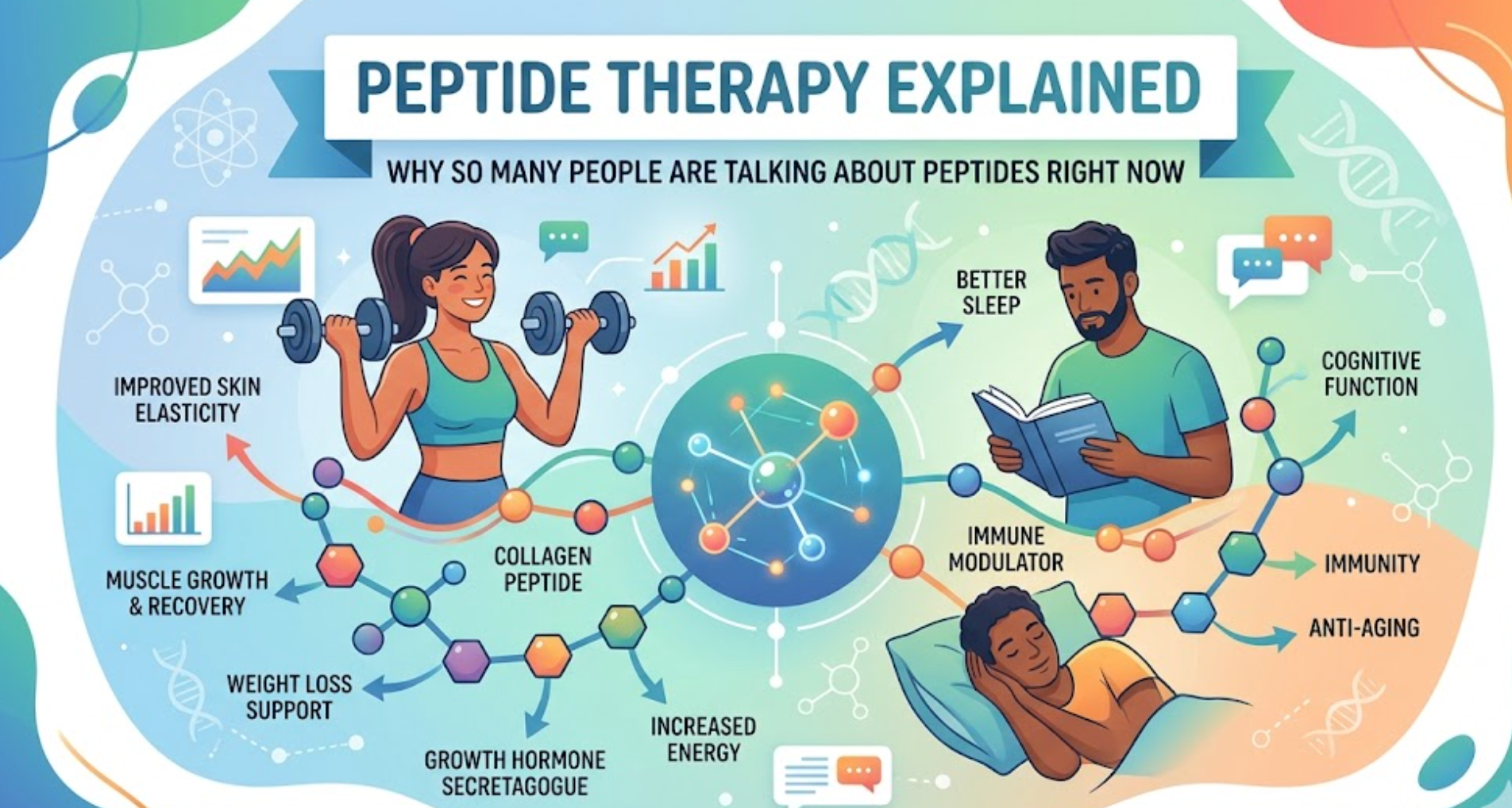
Peptides are short chains of amino acids that act as signaling molecules in the body.
Different peptides are involved in different processes, including tissue repair, inflammation, metabolism, hormone signaling, and recovery.
This has made peptide therapy a growing area of interest in wellness and regenerative medicine.
The appeal is understandable.
Rather than simply masking symptoms, peptide therapy aims to support specific biological pathways.
But the online conversation often makes peptides sound simpler and more certain than they are.
Not all peptides do the same thing. Not all products are equally reliable. Not every patient is a good candidate. And peptide therapy should not replace appropriate diagnosis, rehabilitation, nutrition, sleep, or medical care.
When used thoughtfully, peptides may be one part of a broader recovery plan.
They are a tool, not a shortcut.
Why More Is Not Always Better
People who feel they are losing physical capacity often respond by doing more.
More workouts. More supplements. More caffeine. More intense recovery treatments.
Sometimes the body does not need more stimulation.
It needs enough time and support to complete the repair process.
Training without recovery does not create adaptation. It creates accumulating stress.
The same is true outside the gym.
Long work hours, poor sleep, emotional strain, and inconsistent nutrition can create a recovery deficit even in someone who appears healthy and productive.
The most effective intervention may not be another performance strategy.
It may be reducing the number of demands the body is trying to recover from at once.
A Better Way to Think About Recovery
Recovery should not be treated as something you earn after pushing hard enough.
It is part of the process that allows growth, strength, performance, and health to continue.
The body adapts during recovery, not during stress itself.
Exercise provides the signal.
Recovery produces the result.
The same pattern applies emotionally and physiologically. Stress creates demand. Recovery restores capacity.
When people say they no longer heal like they used to, the answer is not always a single treatment.
It may require improving several parts of the system at the same time: sleep, nutrition, movement, inflammation, stress, hormones, and cellular energy.
That approach is less dramatic than a quick fix.
It is also more realistic.
Clinical Perspective
People often come to Ayafusion looking for one thing that will make them feel better.
A peptide. An infusion. NAD+. Hormone support.
Those therapies may be useful, but the first question is always broader:
What is preventing this person from recovering?
Sometimes the answer is primarily biological. Sometimes it is poor sleep, chronic stress, inadequate nutrition, overtraining, or several factors working together.
The most effective plan is rarely built around chasing one symptom.
It is built around helping the body regain its ability to adapt, repair, and return to balance.
The Bottom Line
Your body has not forgotten how to heal.
But the conditions that support healing may have changed.
Recovery becomes slower when inflammation remains elevated, sleep is poor, stress is constant, nutrition is inadequate, hormones are disrupted, or cellular energy production is under strain.
The good news is that many of these factors can be evaluated and improved.
The goal is not to return to the body you had at twenty.
It is to help the body you have now function with greater strength, resilience, and capacity.
Explore Personalized Recovery Support at Ayafusion
Ayafusion provides personalized wellness care designed to support energy, recovery, metabolic health, and healthy aging.
Depending on your needs, this may include NAD+ therapy, peptide therapy, IV nutrient support, hormone evaluation, medical weight management, and practical guidance around the factors influencing how your body heals.
Ayafusion Wellness Clinic serves patients in Downers Grove and throughout the greater Chicago area who are looking for a thoughtful, medically guided approach to recovery and long-term wellness.
Many people searching for peptide therapy near Chicago, NAD+ therapy, recovery support, or personalized wellness care in Illinois discover Ayafusion through educational resources like this.

What Does Healthy Aging Actually Mean? Building Strength, Energy, and Resilience for the Years Ahead